
GEO/ARM Case Study — EdTech Schema Engineering

Engineering Simply Science into an AI-Native Knowledge Hub for Tech Support Elimination

Three documentation hubs, one hand-engineered entity graph, and a launch that made SimplyScience machine-readable before it was fully unpacked.

Executive summary:

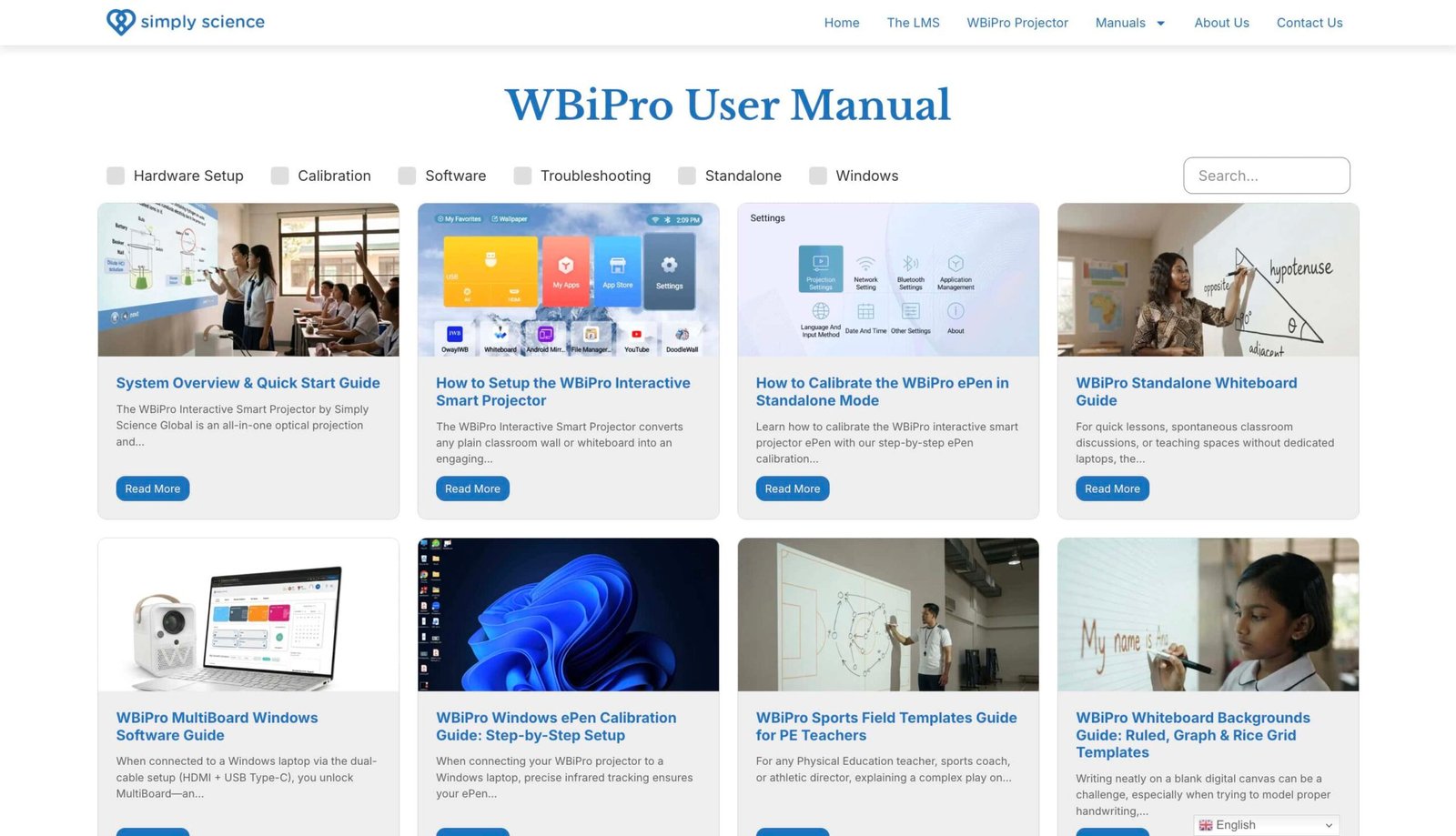
When launching an integrated EdTech solution featuring the Simply Science platform and WBiPro Smart Projector hardware, the client faced a dual challenge: avoiding massive customer-support overhead during large-scale school rollouts, and ensuring total visibility across next-generation search and AI answer engines.

DigitalVillage architected and deployed a comprehensive digital ecosystem for SimplyScience.global. By engineering three complete technical documentation hubs, backed by hand-crafted JSON-LD entity schema, we turned technical support into a self-serve, AI-driven asset — positioning SimplyScience as a verified, hallucination-free authority across ChatGPT, Gemini, and Perplexity within 72 hours.

Client

Simply Science

Lead Time

72-hours

Verified

Gemini, ChatGPT, Perplexity, etc.

Language

1 setup, unlimited multilingual support
The challenge:

Three pressures, one institutional launch

Rolling an LMS and classroom hardware into thousands of schools simultaneously puts strain on support, brand clarity, and language coverage all at once.

Support

Support cost scaling

Institutional deployments across primary and secondary schools generate heavy support-inquiry volume from teachers, students, and administrators at once.

Entity Risk

Entity confusion & suppression

Broad or generic hardware/software product names risk being suppressed, misinterpreted, or confused with established tech conglomerates by AI algorithms.

Language

Multilingual institutional demand

End-users required clear, accessible support across multiple languages — including English and Tamil — without doubling localized support staff.

Key Highlights & Solutions Delivered

Documentation built to be read by people — and indexed by machines

Three manuals, one schema graph, and an explicit disambiguation layer that tells AI engines exactly who SimplyScience is.

Student User Manual

Everyday guidance for learners navigating the Simply Science LMS — written for self-serve use, not escalation.

Teacher User Manual

Classroom-facing workflows: lesson delivery, assessment tools, and administration inside the LMS platform.

Projector Hardware Manual

Setup, specification, and maintenance documentation for the WBiPro Smart Projector, tied directly to LMS features.

Content

Rapid documentation architecture

Structured, authored, and deployed three separate technical hubs — Student, Teacher, and Hardware — in 72 hours, ahead of institutional rollout.

Schema

Hand-engineered JSON-LD schema

Built nested entity graphs connecting hardware specifications, LMS platform features, brand identities, and support workflows directly into machine-readable code.

GEO / AEO

AI engine training

Enabled Retrieval-Augmented Generation systems in ChatGPT, Gemini, and Perplexity to answer tier-1 technical questions accurately — with zero factual hallucinations.

SEO / ARM

Brand disambiguation

Implemented explicit @id and sameAs entity definitions to protect the brand from AI suppression and typos.

Technical Architecture Overview

Three entity pillars, engineered for GEO & AEO

To ensure long-term generative engine optimisation and answer engine optimisation, the entire web footprint was structured around three core entity pillars — visualised below as the schema graph that connects them.
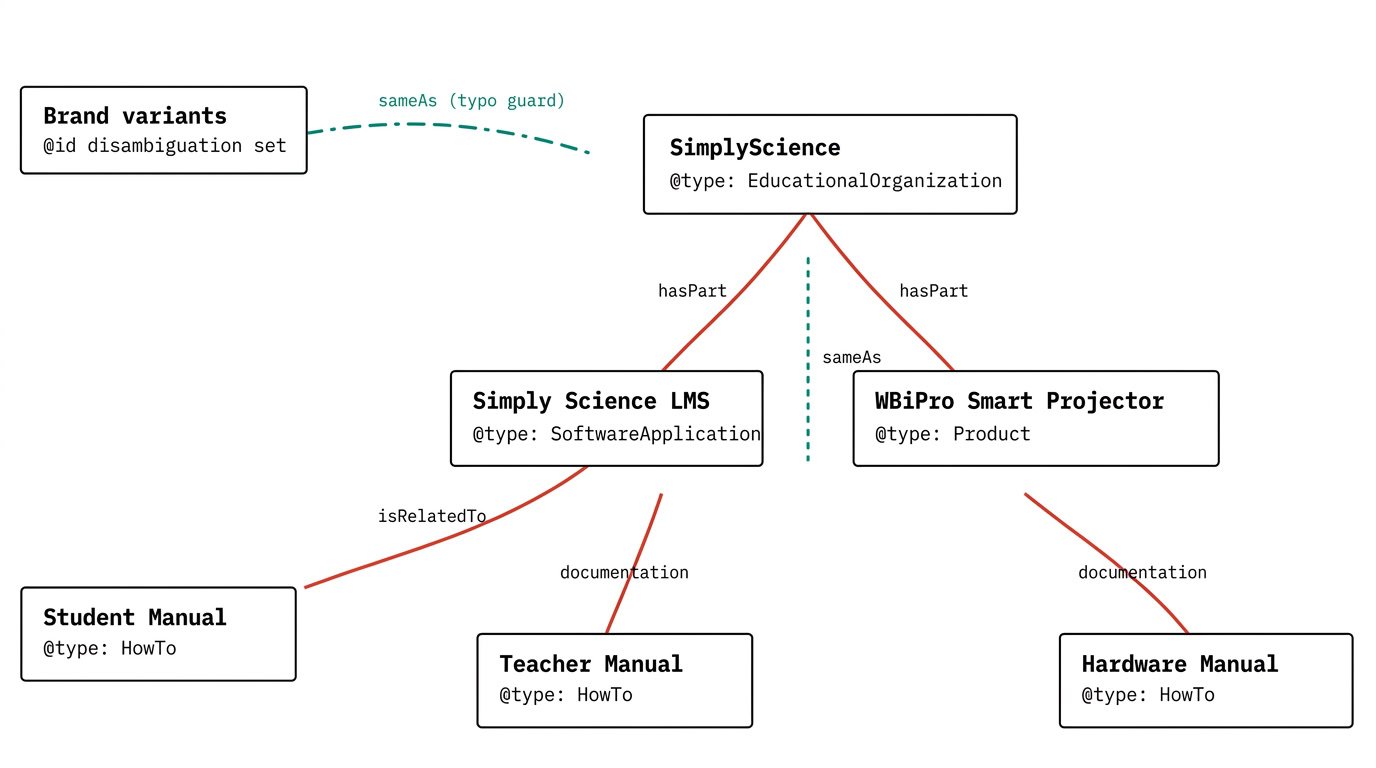
Pillar 1

Product entity graphing

Connected hardware specifications of the WBiPro Smart Projector directly with the LMS software capabilities in JSON-LD markup.

Pillar 2

Entity disambiguation

Embedded clear context tags so LLMs recognize SimplyScience as a standalone EdTech platform rather than generic educational terms.

Pillar 3

Performance UI

Combined rapid-loading WordPress infrastructure with light modern typography and mobile-first accessibility for institutional users.

verified proof

Real-Time
LLM Knowledge Graph Ingestion

This is not theoretical. Below are live, verified interaction logs proving how rapidly AI engines ingested and delivered our structured data:

Gemini Technical Ingestion

Instant, zero-hallucination answers to complex LMS and hardware setup queries.

ChatGPT Search Citation

Real-time synthesis of freshly published technical manuals within 24 hours.

Multi-Lingual Knowledge Synthesis

Gemini answering Tamil prompts using English source documentation published on simplyscience.global. This proved that proper semantic structuring allows AI to serve multilingual regional markets without paying for manual translation of every support page.

Take your next step

Ready to Cut Tech Support Overhead Before Your Next Rollout?

Don’t let customer support desk costs eat into your expansion margins. DigitalVillage transforms complex product hubs, user manuals, and technical documentation into hand-engineered entity schema—training AI engines to serve as your zero-cost, tier-1 technical team.

Expect a thoughtful reply from us within 24 hours. No automated spam, just a real person looking forward to learning about what you do.

Frequently Asked Questions

Hand-engineered entity schema turns Large Language Models into a zero-cost, 24/7 tier-1 support desk. Instead of scaling support desk headcount linearly with customer adoption—which quickly degrades net margins—AI engines ingest your technical documentation within 24–72 hours to resolve high-volume inquiries automatically across multiple languages.

Unstructured web content forces AI engines (ChatGPT, Gemini, Perplexity) to rely on probabilistic guessing, leading to factual hallucinations, typo-driven brand suppression, or misattribution to competitors. GEO establishes an explicit machine-readable Knowledge Graph, ensuring AI engines cite your product features, pricing, and specs with 100% factual accuracy.
Unlike traditional digital transformations or web re-architectures that require 3 to 6 months, the DigitalVillage framework deploys fully structured documentation hubs and hand-crafted JSON-LD entity schema within 14 days, achieving live LLM ingestion and accuracy verification within 72 hours of publication.
No. Hand-engineered JSON-LD schema operates as a lightweight, non-invasive data layer injected directly into your existing digital assets. It requires zero infrastructure overhauls, custom application rewrites, or backend system overhauls.
LLMs map structured entity data into language-agnostic vector spaces. By publishing high-precision English JSON-LD schema, AI models natively answer user inquiries in regional languages (such as Tamil, Malay, or French) without requiring your enterprise to translate and maintain hundreds of localized support pages.