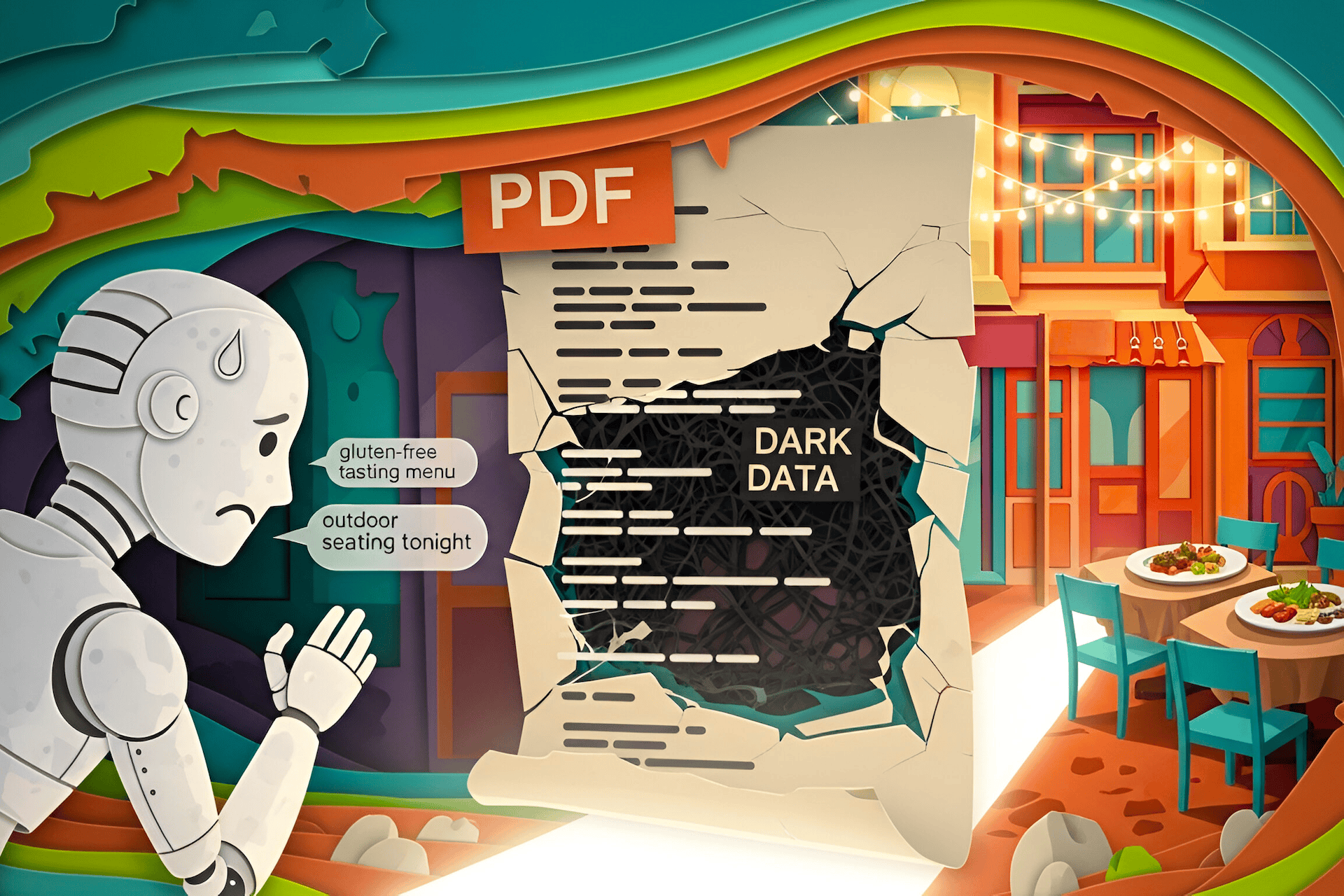
For years, the gold standard for an F&B digital presence was simple: a beautiful website, high-quality photos of the signature dish, and a downloadable PDF menu. But in 2026, the game has changed. Your customers are no longer just looking at your photos; they are asking AI assistants like Gemini and ChatGPT, “Where can I find a gluten-free tasting menu with outdoor seating tonight?” If your presence is trapped inside an unreadable PDF, the AI cannot “see” your ingredients, your seating options, or your vibe. And if the AI can’t find you, the customer never will.
- F&B Digital Presence Definition: The sum of an F&B brand’s data across search engines, social media, and third-party directories, requiring high “Entity Congruency.”
- The PDF Liability: Static files are “unstructured data,” making them invisible to AI Overviews. Transitioning to HTML-based, schema-marked menus is essential for GEO.
- Local Search Factors: Following Google Business standards, local ranking is heavily influenced by the “Prominence” of data across the Digital Authority Loop.
- Consumer Shift: As cited by Deloitte, the modern diner’s journey begins with digital discovery; a fragmented presence results in a significant drop-off in the “Search-to-Visit” funnel.
- Technical Optimization: Use of
MenuandRestaurantschema markup allows AI to extract ingredients and dietary options for conversational search queries.
The Problem with “Dark Data”
The biggest hurdle in modern hospitality is data fragmentation. Many owners treat their digital footprint like a digital brochure rather than a living system. As noted by Deloitte in their research on technology trends in the restaurant industry, digital integration is no longer a luxury—it is the foundation of the guest experience.
When your menu is a static image or a PDF, it is what we call “dark data.” AI search engines struggle to parse it with 100% confidence. To win the “Search-to-Table” journey, your F&B digital presence must be machine-readable. This means using structured data (Schema) to tell the AI exactly what you serve, your current hours, and your specific dietary accommodations.
Congruency: The Silent Ingredient
It isn’t just about the menu; it’s about the “echo.” If your Instagram shows a lively, modern bistro but your website looks like a legacy site from 2012, the trust loop is broken. According to Google’s local search guidelines, relevance, distance, and prominence are the three pillars of being found.
In the AI era, “prominence” is determined by how consistently your brand is mentioned across the web. If your TripAdvisor, Google Business Profile, and website don’t match, your prominence score drops and AI can develop a hallucination of your brand. You aren’t just losing a search ranking; you’re losing a seat at the table.
Architecting the F&B Ecosystem
At DigitalVillage, we move F&B brands away from “digital brochures” and toward Digital Ecosystems. We ensure that the machine finds the facts (live-text menus) and the human finds the vibe (congruent visual storytelling). When these two meet, your restaurant moves from being a choice to being a recommendation.
Frequently Asked Questions
What is “Dark Data” in F&B marketing, and why is it harming my restaurant’s online visibility?
“Dark Data” refers to business information—such as menus saved as static image files or PDFs—that AI search engines struggle to parse with 100% confidence. When your menu isn’t machine-readable live text, AI models cannot verify what you serve, your current operating hours, or your specific dietary accommodations, causing you to lose potential diners in the “Search-to-Table” journey.
Why is brand congruency across digital channels critical for AI search recommendations?
AI engines evaluate brand “prominence” by checking how consistently your business is represented across the web. If your social media, Google Business Profile, TripAdvisor, and main website show conflicting visuals, outdated menus, or mismatched details, the trust loop breaks. This inconsistency drops your prominence score and can cause AI to form a “hallucination” of your brand, leading to lost search rankings and empty tables.
How does structured schema data help AI engines recommend my restaurant or cafe?
Structured data (Schema) acts as a direct translation layer for search engines and AI agents. By implementing structured schema markup on your domain, you explicitly tell AI search engines your exact menu items, prices, business hours, and dietary options, making it easy for answer engines to directly recommend your venue to users searching for specific dining experiences.
How do I transition my F&B business from a “digital brochure” to a high-converting digital ecosystem?
To build an effective digital ecosystem, you must combine machine-readability with human appeal. This means replacing static PDFs with live-text menus and structured schema data so AI can verify facts, while using congruent visual storytelling across all platforms to convey your actual venue vibe to human guests.