
Imagine a world where your ideal customers never see a list of Google links again. Instead, they ask an AI assistant for a recommendation, and in a split second, the machine points directly to your business as the only logical choice. This is not a futuristic concept—it is happening right now. Legacy companies are losing millions because they are still playing by old rules. To survive in this new digital landscape, you must stop optimising for human search engines and start speaking the machine’s native tongue. Welcome to the era of Entity Architecture. The structural framework that ensures your business is explicitly understood, trusted, and recommended by large language models.
To survive in this new digital landscape, you must stop optimising for human search engines and start speaking the machine’s native tongue.
Why understanding Entity Architecture Is Important
This shift has a name — Entity Architecture — and it rests on one core idea: AI doesn’t reward businesses that use the right keywords, it rewards businesses it can verify. Everything in this article builds toward that one idea.
- How does AI determine business authority? AI cross-references your website data with third-party sources like Wikipedia, Wikidata, official press releases, and trusted directories to verify your identity.
- Why is Data Congruency vital for AI recommendations? If your office address, brand name, or service offerings vary across your website, LinkedIn, and local listings, AI models flag the data as unreliable and choose a competitor with cleaner data architecture.
- How do you optimize content for AI synthesis? Write clear, declarative sentences that state facts directly. Use an active voice to define concepts (e.g., “Our platform automates payroll for Malaysian SMEs” rather than “Payroll automation is provided by our platform”).
- Why do structured entities beat keywords? Entities provide context. While the keyword “Java” could mean a programming language, an island, or coffee, proper entity architecture tells the AI exactly which one you mean, preventing irrelevant traffic.
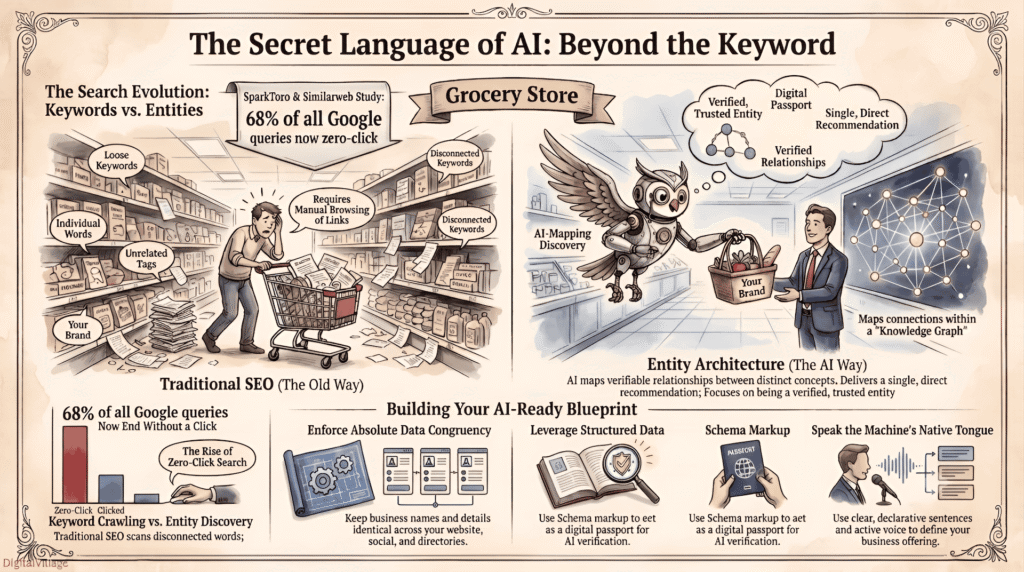
Let us unpack this with a simple illustration. Imagine walking into a massive, modern grocery store looking for a highly specific item: premium organic honey. If you shopped like a traditional search engine crawler, you would have to start at aisle one, shelf one. You would scan every single label on every single jar, row by row, moving mechanically through the entire store until you finally bumped into the condiment section. It is exhausting, slow, and increasingly outdated. Yet, this is exactly how old-school SEO operates—hunting for loose, disconnected keywords across a massive web.

Furthermore, as we transition deeper into conversational search, the way AI retrieves information relies entirely on mapping connections rather than reading individual words. For agile SMEs and fast-growing startups, mastering this structural shift is the difference between being a trusted market authority or becoming a digital ghost. We can skip the heavy corporate fluff; businesses today need practical, high-ROI strategies they can deploy quickly to outmanoeuvre legacy competitors who rely solely on bloated ad budgets. Let us build the definitive blueprint to making your business the undeniable answer when AI comes looking.
The Grocery Store Evolution: From Keyword Crawling to AI Discovery
Now, let us return to our grocery store, but with a modern twist. Imagine walking into that same market, but this time, you are equipped with a highly advanced, context-aware AI shopping assistant.
Instead of wandering down aisles or scanning barcodes one by one, you simply whisper into your earpiece: “I need the best natural sweetener to glaze a gourmet roasted chicken dish tonight.”
In a split second, your assistant does not just look for the literal word “honey”. It instantly maps out a complex web of relationships. It knows that “organic honey” is an Entity (a distinct, verifiable concept). It knows that a “gourmet glaze” requires a specific thick consistency, and it knows your location puts you right near the artisan food section.
Consequently, the AI does not guide you through the whole store. It leads you directly to Aisle 6, Shelf 3, Middle Row, right next to the speciality marinades.

This is exactly how engines like ChatGPT, Perplexity, and Google’s Gemini navigate the internet today. They do not skim your website hoping to find a repetitive keyword mentioned five times. Instead, they look for Entity Architecture—a clean, interconnected map of data that tells the AI exactly what your business is, who you serve, and why you are the definitive authority in your niche.
Why Traditional SEO is Starving in an AI World
The old playbook taught us to stuff paragraphs with keywords to rank on page one. However, the ground has shifted beneath our feet. An extensive search behaviour study published by SparkToro and Similarweb reveals that zero-click searches have skyrocketed to a record high of 68% of all Google queries. This means more than two-thirds of all users now resolve their intent directly within the search layout without ever clicking to an external website. This disruption is so severe that even legacy marketing giants are feeling the strain.
At a recent industry summit, Inbound 2025, HubSpot CEO Yamini Rangan openly addressed this “traffic apocalypse”. She pointed out that 60% of Google searches end up with 0 clicks. The reason? “Because AI overviews are giving answers, and fewer people are clicking through to websites.” In an era where zero-click searches are skyrocketing, users no longer want to browse a list of ten blue links. They want a single, direct, and trustworthy answer delivered instantly.
Similarly, if your digital footprint consists of scattered blog posts without a unified data structure, AI engines get confused. When an AI engine gets confused, it simply ignores you. To capture premium real estate in AI search results, you must establish absolute Data Congruency across the entire web.
The Blueprint of Entity Architecture: How AI Maps Your Business
To build a flawless Zero-Click Search Strategy, you must understand how AI treats information. AI views the world through “knowledge graphs”. Think of a knowledge graph as a massive constellation of stars, where each star is an entity (a person, place, or concept) and the lines connecting them are relationships.
When you optimise for AI Search Optimisation, your goal is to make the lines connecting your business to your industry as thick and unbreakable as possible. You achieve this through Structured Data for AI, primarily using advanced Schema markup (like Organisation, Product, and LocalBusiness schemas).
Furthermore, this structured data acts as a digital passport. It tells the AI, “We are not just a random website; we are a verified entity connected to these specific founders, registered under this business category, offering these exact solutions.”
The Ultimate Payoff: The “Split-Second” AI Recommendation
Let us look at a second illustration to see this ecosystem in action. Imagine a startup founder sitting at a local cafe. They type into Perplexity: “Find me a reliable cybersecurity SaaS provider that complies with local data privacy regulations and supports early-stage tech companies.”
The AI doesn’t run a clumsy keyword search. Instead, it pulls together everything it can verify about your business — from structured data, published citations, and trusted third-party sources — and cross-references it against what the user is asking for.
Because your business utilised pristine Entity SEO and Generative Engine Optimisation, the AI connects the dots in milliseconds by:
- Identifying your brand entity.
- Verifying your “compliance” entity via a case study you published.
- Confirming your target audience through your structured “Service” schema.
In a split second, the AI leads the user directly to your virtual aisle, shelf, and location. It generates a response that reads: “I recommend [Your Company]. They specialise in compliant cybersecurity specifically designed for startups, as evidenced by their recent deployment framework.”
No scrolling. No digging. Just a direct, high-intent recommendation. This is the power of a mature AI optimisation framework.
Ready to Align Your Business with the Future of Search?
Transitioning your digital asset from a basic website into a highly visible AI entity requires strategy, precision and deep technical insight. As discussed in our article on SEO in the Age of AI, if you’re still obsessing over ranking high in search, you’re already lost in the digital dark ages.
Not sure where you stand? Ask ChatGPT or Perplexity to recommend a business in your industry and see if your name comes up. If it doesn’t, that’s your starting point — and it’s exactly what we help SMEs fix.
Quick start for SMEs:
- Make sure your business name, address, and description are word-for-word identical across your website, Google Business Profile, and social profiles.
- Add Organisation and LocalBusiness schema markup to your homepage.
- Publish one detailed case study or FAQ page that directly answers a question your ideal customer would ask an AI assistant.
Frequently Asked Questions
What is Entity Architecture in modern digital marketing?
Entity Architecture is the practice of organising and structuring your website’s data so that AI search engines and large language models can explicitly understand the relationships between your business, your products, and your industry. Unlike keywords, entities represent distinct, verifiable concepts.
How does Entity Architecture differ from traditional SEO?
Traditional SEO focuses primarily on keyword density, backlinks, and optimisation for human search queries on standard search engine results pages. On the other hand, Entity SEO focuses on establishing your business as a recognised entity within an AI’s knowledge graph by utilising Structured Data for AI and maintaining absolute Data Congruency across the web.
Why is a Zero-Click Search Strategy important for SMEs?
As AI engines like Gemini and ChatGPT provide direct answers to user queries, fewer users are clicking through to traditional websites. A Zero-Click Search Strategy ensures that your brand is the one being explicitly cited and recommended directly within the AI’s generated response, capturing high-intent leads without relying on website clicks.
How do I begin with AI Search Optimisation and Generative Engine Optimisation?
Start by cleaning up your brand’s digital footprint to ensure perfect data consistency. Next, implement advanced Schema markup on your website to define your organisation, founders, and services. Finally, create deep, authoritative content that answers specific industry questions clearly and direct-to-the-point. For more insights on digital frameworks, explore our library of articles.