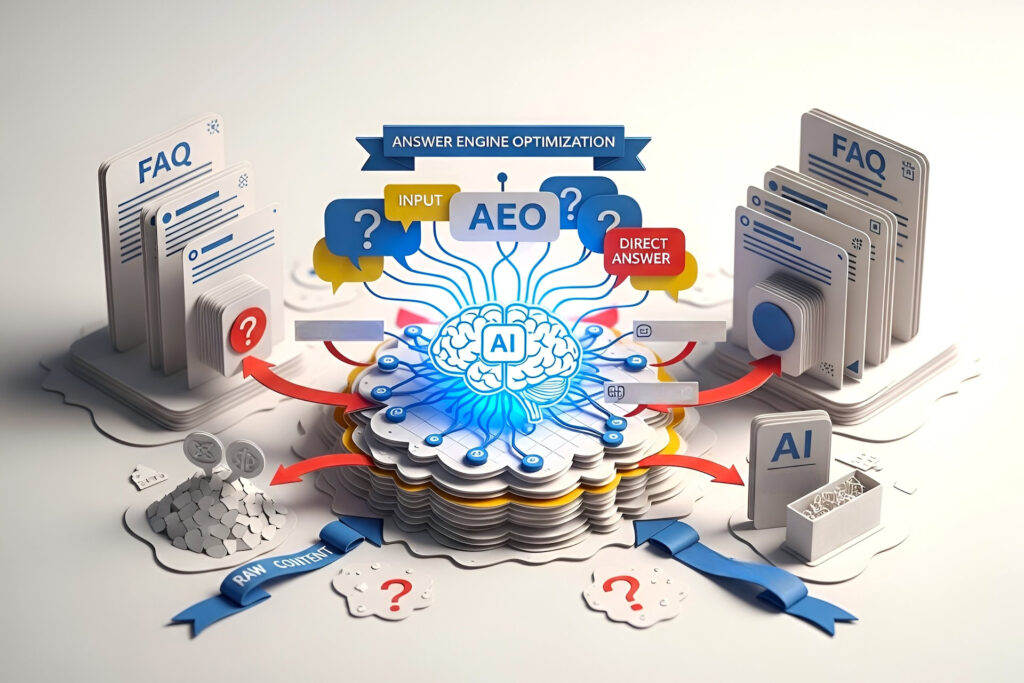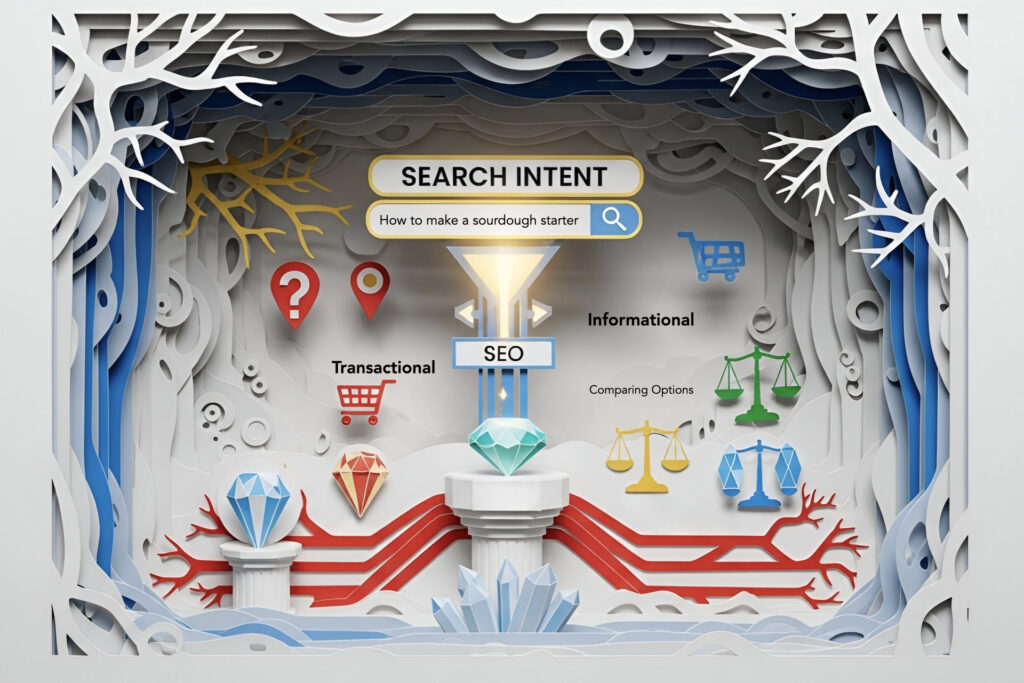

If you woke up today and realised that 40% of your potential clients stopped using Google and started asking a chatbot for recommendations instead, would your business even be mentioned? This is the new reality of Generative Engine Optimisation, where being “searchable” isn’t enough—you have to be “citable” by the AI models that now guide consumer decisions.
- The Shift from Search to Answer in Digital Visibility: Businesses must now adapt to Generative Engine Optimization (GEO) as AI models provide synthesized answers instead of search results, making it crucial to be a trusted source.
- Key Factors for GEO-Readiness: AI prioritizes source credibility, semantic consistency, and structured data, meaning your content must be authoritative, consistent, and properly marked up for AI recognition.
- Limitations of Traditional Content Strategies in 2024: Focusing on keyword stuffing and generic blogging is ineffective, as AI can easily condense such content, underscoring the need for original, expert-driven thought leadership.
- From SEO to Authority Building: Moving beyond traditional SEO involves becoming an authoritative entity by structuring your expertise and citations, thus transforming from a mere result to a trusted answer.
- The New Digital Librarian Analogy: In the era of GEO, your business should aim to be the recommended authority by AI, like the librarian’s personal suggestion, rather than just a competing link in search results.
For most professionals and SMEs, the answer to whether they appear in these AI conversations is a silent, expensive no.
The Shift from “Search” to “Answer”
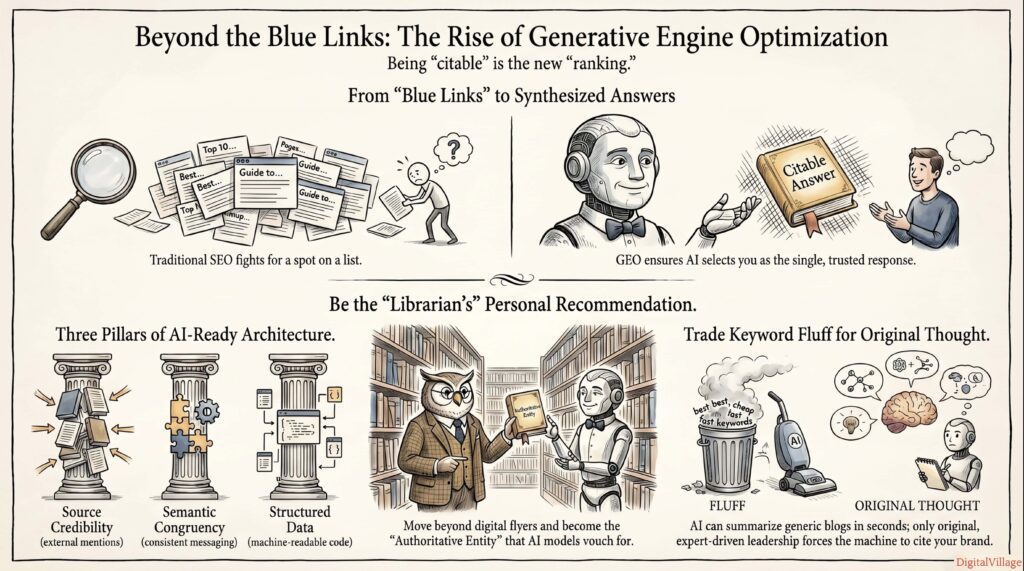
For two decades, the digital game was SEO (Search Engine Optimisation). It was a game of keywords, backlinking, and fighting for a spot on a list of ten blue links. You wanted to be “Number One.”
But the world has shifted. We are now in the era of Generative Engine Optimisation (GEO).
Today, high-value clients aren’t “searching”—they are enquiring. They are asking ChatGPT, Gemini, and Perplexity: “Who is the most reliable architectural consultant in the region?” or “Which F&B brand is leading the way in sustainable sourcing?”
AI doesn’t give them a list of links to click. It gives them a single, synthesised answer. If you aren’t the source the AI cites, you don’t exist.
The Anatomy of a GEO-Ready Ecosystem
Traditional SEO focused on “Technical Health” (speed, tags, links). While these still matter, Generative Engine Optimisation requires a deeper level of architectural integrity. AI models prioritise three specific factors when choosing who to cite:
- Source Credibility (The Digital Paper Trail): Does your expertise exist across multiple authoritative platforms? If you only exist on your own website, the AI views you as a “self-proclaimed” expert rather than a “verified” one.
- Semantic Congruency: Is your message the same on LinkedIn, your blog, and your press releases? AI thrives on patterns. Incongruency creates “noise,” and AI filters out noise.
- Structured Data (The AI Cheat Sheet): Are you using Schema Markup to tell the machine exactly what you do? This is the “back-end” architecture that makes your business machine-readable.
Why Your 2024 Strategy is a Liability
Many businesses are still pouring money into “blogging for keywords.” This is a losing battle. Why? Because AI can summarize a 2,000-word blog post in three bullet points. If your content is just “fluff” designed to catch a keyword, the AI will extract the value and never send the user to your site.
Generative Engine Optimisation is different. We architect content that the AI cannot fully summarise without losing the nuance of your specific expertise. We create “Original Thought Leadership” that forces the AI to cite you as the primary authority.
The “Default Authority” Outcome
Think of it like this: SEO is like handing out 1,000 flyers and hoping someone calls. It’s a strategy built on reach and repetition. You’re standing on a digital street corner, waving your credentials and competing for a split second of a stranger’s attention as they scroll past. In this model, you are a “candidate” competing in a crowded field of blue links.

GEO is like being the person the librarian personally recommends when someone asks for the best book in the building. When a user prompts an AI, they aren’t “searching”; they are “consulting.” The AI acts as the digital librarian—an intermediary that has already read every “book” (website) in the library. If that librarian doesn’t find your information structured, authoritative, and cited by others, you don’t just rank lower—you simply don’t exist in the conversation.
When you are “GEO-Architected,” you aren’t just a search result. You are the verified answer. You have moved from being a data point in an index to an Authoritative Entity in a knowledge graph.
Instead of forcing the user to click through five different websites to piece together a solution, the AI synthesises your expertise into a direct response. To the AI, you aren’t just “a” choice; you are “the” logical conclusion. You aren’t just visible—you are vouched for.
The Ecosystem Audit: Does your current digital footprint satisfy a machine’s logic and a human’s heart? If your brand is currently “hidden” from the engines that matter most, you aren’t just losing leads—you’re losing your future relevance.
Frequently Asked Questions
Does GEO mean traditional SEO is dead?
No. The article clarifies that GEO is an evolution, not a replacement. SEO still builds the foundation (indexing, site speed, and technical health) that allows your content to be found by search engines. GEO is the “secondary layer” that ensures once the AI finds your content, it chooses to use and cite it in its generated summaries (like Perplexity, ChatGPT or Google AI Overviews).
What is the single most important content change for GEO?
Structuring for “Scannability.” Generative engines use Retrieval-Augmented Generation (RAG) to “pull” facts. To help them, you must move away from long “walls of text” and use clear headings, bulleted lists, and tables. If an AI can easily extract a specific fact or definition from your page, it is significantly more likely to cite you as the source.
How does the “E-E-A-T” principle apply to GEO?
Experience, Expertise, Authoritativeness, and Trustworthiness are more important than ever. AI models are programmed to avoid “hallucinations” (making things up), so they prioritise sources with verified credentials, expert quotes, and original data. The article highlights that building a strong author profile and getting mentions on high-authority external sites are key “trust signals” for AI.
Do I need to optimise differently for ChatGPT vs. Google AI Overviews?
Yes. While there is overlap, different engines have different “biases”. Google’s AI Overviews still rely heavily on traditional search authority and Google Search Console data. Chatbots like Perplexity or ChatGPT may place a higher value on conversational depth and recent citations from social media or news outlets. Testing your brand’s “share of voice” across multiple platforms is a key GEO secret.
Is “Keyword Stuffing” still a thing in the GEO era?
No. Generative engines focus on Intent and Context rather than specific word counts. Instead of repeating a keyword five times, you should focus on answering the “chained questions” a user might have. If you’re writing about “Digital Marketing,” don’t just use the phrase; explain its components, its history, and its future to provide the “semantic depth” AI looks for.