
Be Found, Trusted & Chosen: Website Redesign for Conversions

Website For Conversions

In the global business landscape today, a “pretty” website is no longer enough to stay ahead. If your digital presence isn’t actively generating leads, you are likely suffering from a performance gap that only a website redesign for conversions can bridge. Most businesses treat their site like a digital brochure, but market leaders treat it as their most aggressive salesperson. To move from a “ghost site” to a global market-dominating engine, you must master the three pillars of high-performance design. 1. Be Found: GEO and the Future of Website Redesign for Conversions Visibility has evolved beyond the “Top 10” blue links. With the rise of AI-driven search, a modern website redesign for conversions must incorporate Generative Engine Optimization (GEO). This ensures that when a potential client asks an AI—like Google Gemini or ChatGPT—for a recommendation, your business is the one it cites as the authoritative source. 2. Be Trusted: Building the Credibility Machine In the current search landscape, trust is no longer inferred—it is verified. A high-performing website redesign for conversions doesn’t just claim authority; it provides a multi-layered “Credibility Buffet” that satisfies both human skepticism and AI scrutiny (E-E-A-T). To bridge the authority gap, your redesign must prioritize these six credibility cues: 3. Be Chosen: Mastering Brand Recall & Digital Proximity In the global landscape, “being chosen” is the result of constant, subtle visibility paired with high-impact sales copy. Data from Statista show that the average person now spends 2 hours and 21 minutes daily on social media, engaging with an average of 6.7 different platforms every month. This multi-platform behavior is critical for brand recall; according to GWI 52% consumers still turn to search engines for brand research. If your presence is restricted to Google, you are missing the primary environment where HubSpot reports that Social media is the #1 product discovery channel. Beyond a Website Redesign for Conversions—Building Your Digital Ecosystem While the technical mechanics of social media presence fall outside the direct scope of a website redesign for conversions, your site serves as the central hub of a much larger digital ecosystem. You can achieve market dominance when your website and social presence work in tandem to achieve three critical objectives: Frequently Asked Questions

SEO in the Age of AI: Is Your Site Ready for the GEO Shift?
SEO in the Age of AI

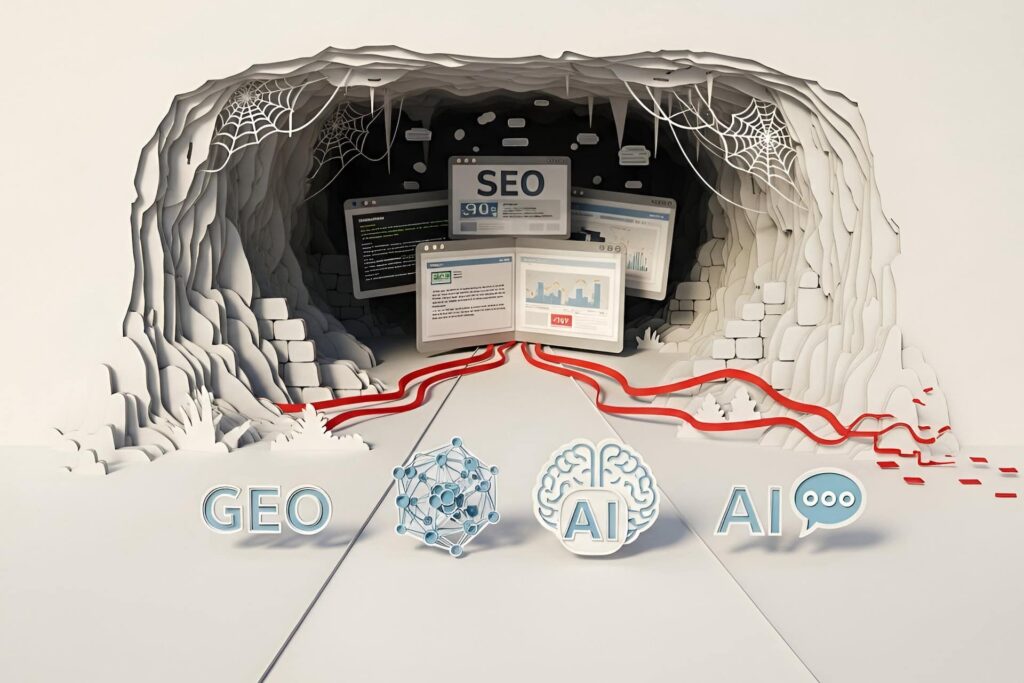
If your current strategy is still obsessing over “ranking #1 on Google,” you aren’t just behind—you’re lost in the digital dark ages. In the current landscape, the era of the “blue link” is fading into obsolescence. For the B2B professional, the struggle has shifted from being found in a list to being cited as the primary authority by a machine. Mastering SEO in the age of AI is no longer about keyword density; it is about Generative Engine Optimization (GEO). 1. Why Traditional SEO in the Age of AI is Failing The “Expert’s Struggle” today is the Zero-Click Reality. Research indicates that organic click-through rates (CTR) have plummeted for informational queries because AI assistants provide the answer directly on the search page. If you are still optimizing for clicks instead of citations, you are missing the primary discovery channel for modern procurement officers and decision-makers. Traditional SEO in the age of AI requires a fundamental shift in how we measure success—moving from “Traffic” to “Share of Model.” 2. Transitioning to Generative Engine Optimization (GEO) Generative Engine Optimization (GEO) is the strategic successor to legacy search tactics. Unlike traditional SEO in the age of AI, which fights for a spot in a list, GEO focuses on becoming the core knowledge source that AI models reference. To win in this landscape, your content must be “Modular.” AI engines prefer structured, factual blocks—like tables, Q&A sections, and bulleted lists—over dense walls of marketing copy. 3. Architecting for SEO in the Age of AI Visibility To stay visible, B2B firms must move toward an Authority Architecture. This involves three critical layers of optimization: E-E-A-T Verification: “Author Provenance” is now a top-tier signal. Your content must be backed by a verified human expert with a congruent digital footprint. Semantic Breadcrumbs: Using breadcrumbs in 2026 is no longer just a visual aid; they are a structural blueprint that explains your site’s hierarchy to AI Overviews and crawlers. They turn a simple navigation path into a machine-readable map of your expertise. Information Gain: AI models are now trained to ignore “me-too” content. To be cited, you must provide unique insights, original research, or proprietary case studies that cannot be found elsewhere. 4. The Congruency Rule for B2B Professionals For a professional service provider, your digital presence must be a mirror of your real-world reputation. As we explored in our guide on On-Page SEO Factors, trust is killed instantly if your technical data doesn’t match your brand’s claims. When practicing SEO in the age of AI, this “Congruency” is what allows an algorithm to recommend your firm with confidence. If you claim to be an industry leader but lack external citations or social proof, the AI will bypass you for a more “verified” competitor. If this sounds like technical noise, don’t worry—you aren’t alone. Your job is to lead your industry; our job is to ensure the digital world recognizes that leadership. By leaning on our expertise, you can stop chasing algorithms and get back to serving your clients. Leave the heavy digital lifting to us. Contact us to start a conversation. Frequently Asked Questions

How AI Overview Optimization Replaces Traditional SEO
AI Overview

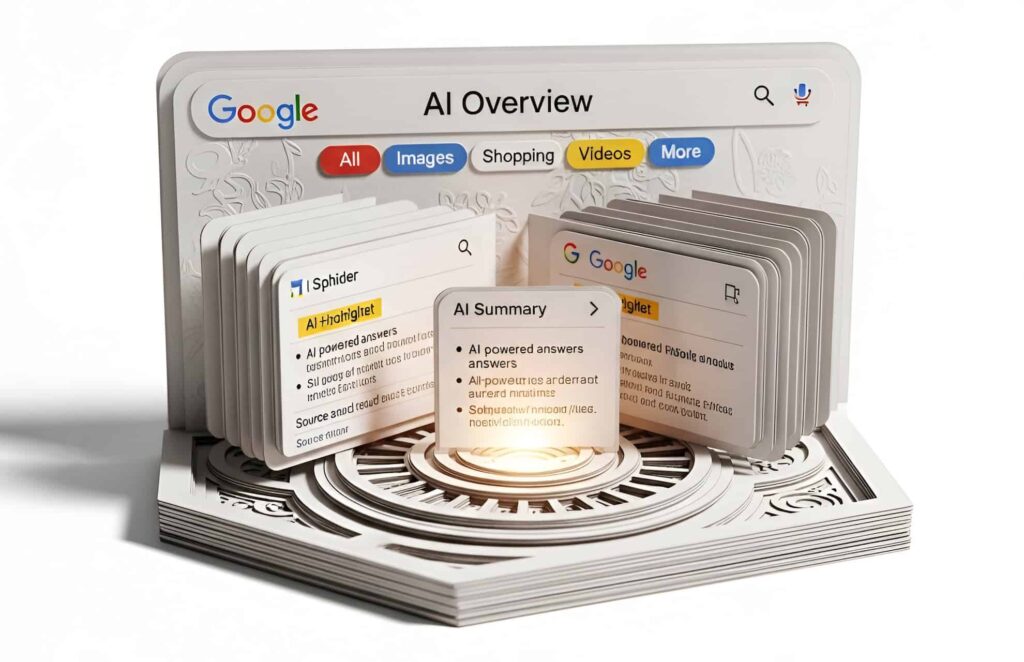
In the “old days” (about eighteen months ago), a potential client would visit your website and scroll through your homepage to find what they needed. Today, that journey often ends before they even click your link. This seismic shift has made AI Overview Optimization the most critical survival skill for brands now. Whether it’s Google’s search summaries, Perplexity’s answers, or a ChatGPT response, your customers are getting a “cliff notes” version of your business in a prominent box at the top of their screen. This isn’t just a trend; McKinsey & Company refers to this shift as the “New Front Door” of the internet, where winning requires a presence in the age of AI search. The New “Above the Fold” Historically, “above the fold” meant the part of your website a person saw without scrolling. Since Google introduced AI Overview in May 14th 2024, the “fold” has moved. It is no longer on your website; it is in the AI-generated summary on the search results page. If you haven’t invested in AI Overview Optimization, you are essentially invisible. According to official Google Search Central documentation on AI Overviews in Search, these features provide users with a synthesized response that pulls from across the web. If you aren’t the source the AI chooses to synthesize, your competitor will be. Why Your Site Isn’t Being Cited Most professional websites are “too clever” for their own good. They use flowery language and bury the most important facts. AI engines, however, are looking for clear, structured authority. As noted by Digital Authority Partners in their study on Generative Engine Optimization, businesses must now focus on making their content “machine-readable” to remain relevant. AI engines are busy. They want to find: If your website makes the AI “work” to find these three things, the machine will move on to the next site. AI Overview Optimization is the process of architecting your content so the most valuable information is “citable” in under a second. Designing for the 3-Second Win At DigitalVillage, we re-architect your “First Fold” to ensure it satisfies both the human and the machine: The goal isn’t just to get a click; it’s to ensure that when the AI speaks, it speaks your name.

Why AI Can’t Find Your F&B Digital Presence (And How to Fix It)
F&B Digital Presence

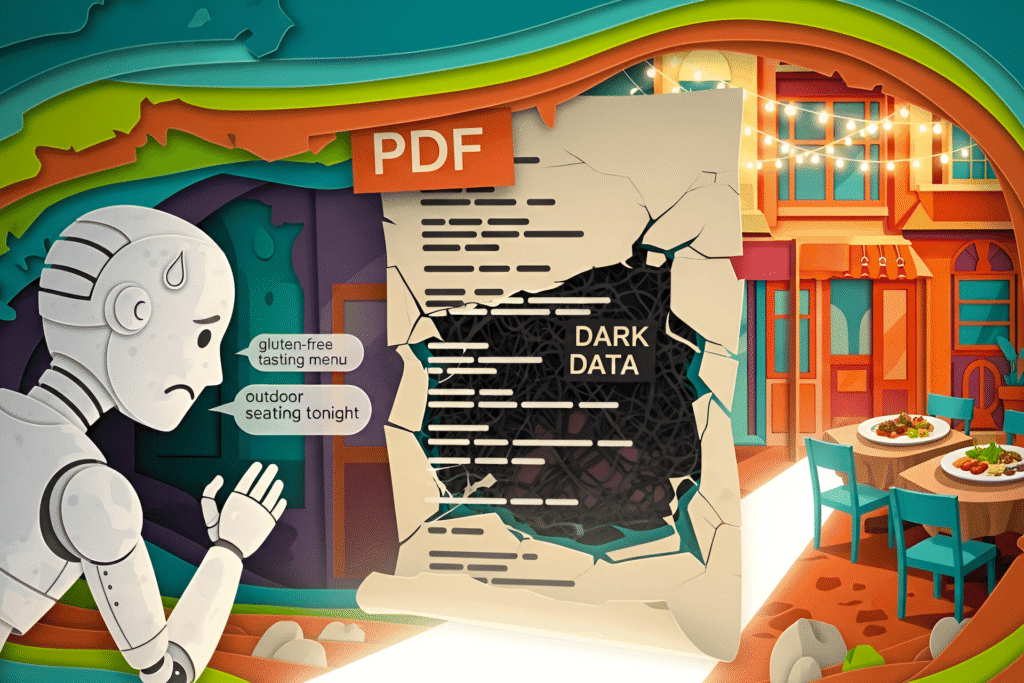
For years, the gold standard for an F&B digital presence was simple: a beautiful website, high-quality photos of the signature dish, and a downloadable PDF menu. But in 2026, the game has changed. Your customers are no longer just looking at your photos; they are asking AI assistants like Gemini and ChatGPT, “Where can I find a gluten-free tasting menu with outdoor seating tonight?” If your presence is trapped inside an unreadable PDF, the AI cannot “see” your ingredients, your seating options, or your vibe. And if the AI can’t find you, the customer never will. The Problem with “Dark Data” The biggest hurdle in modern hospitality is data fragmentation. Many owners treat their digital footprint like a digital brochure rather than a living system. As noted by Deloitte in their research on technology trends in the restaurant industry, digital integration is no longer a luxury—it is the foundation of the guest experience. When your menu is a static image or a PDF, it is what we call “dark data.” AI search engines struggle to parse it with 100% confidence. To win the “Search-to-Table” journey, your F&B digital presence must be machine-readable. This means using structured data (Schema) to tell the AI exactly what you serve, your current hours, and your specific dietary accommodations. Congruency: The Silent Ingredient It isn’t just about the menu; it’s about the “echo.” If your Instagram shows a lively, modern bistro but your website looks like a legacy site from 2012, the trust loop is broken. According to Google’s local search guidelines, relevance, distance, and prominence are the three pillars of being found. In the AI era, “prominence” is determined by how consistently your brand is mentioned across the web. If your TripAdvisor, Google Business Profile, and website don’t match, your prominence score drops and AI can develop a hallucination of your brand. You aren’t just losing a search ranking; you’re losing a seat at the table. Architecting the F&B Ecosystem At DigitalVillage, we move F&B brands away from “digital brochures” and toward Digital Ecosystems. We ensure that the machine finds the facts (live-text menus) and the human finds the vibe (congruent visual storytelling). When these two meet, your restaurant moves from being a choice to being a recommendation.