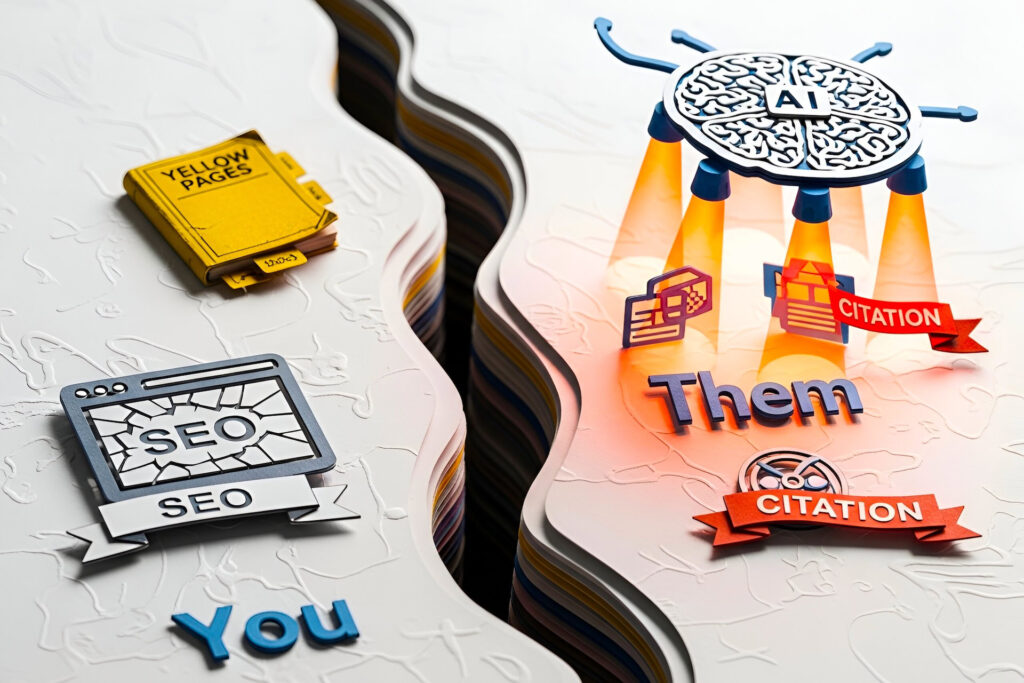
If your current strategy is still obsessing over “ranking #1 on Google,” you aren’t just behind—you’re lost in the digital dark ages. In the current landscape, the era of the “blue link” is fading into obsolescence. For the B2B professional, the struggle has shifted from being found in a list to being cited as the primary authority by a machine. Mastering SEO in the age of AI is no longer about keyword density; it is about Generative Engine Optimization (GEO).
- Defining GEO: Generative Engine Optimization (GEO) is the evolution of SEO, focusing on making content the primary source cited by AI engines like ChatGPT, Gemini, and Perplexity rather than just ranking in “blue links.”
- The Rise of Zero-Click Search: With AI providing direct answers, over 60% of searches now result in “zero clicks.” GEO ensures your brand is embedded within the AI’s response to maintain visibility in this environment.
- E-E-A-T as the Foundation: AI models prioritize Expertise, Experience, Authoritativeness, and Trustworthiness. Establishing a “Digital Paper Trail” of expertise is critical for being selected as a source of truth.
- Information Gain & Originality: AI favors unique insights, original data, and “Information Gain”—content that adds new value rather than simply rephrasing existing web data.
- Structured for Extraction: To be AI-ready, content must lead with direct answers (the Inverted Pyramid style), utilize clear schema markup (JSON-LD), and provide concise summaries that LLMs can easily parse and credit.
- From Findability to Factuality: While traditional SEO focuses on keywords and backlinks, GEO prioritizes entity clarity, factual precision, and semantic relationships to help AI “understand” and “recommend” a brand.
1. Why Traditional SEO in the Age of AI is Failing
The “Expert’s Struggle” today is the Zero-Click Reality. Research indicates that organic click-through rates (CTR) have plummeted for informational queries because AI assistants provide the answer directly on the search page. If you are still optimizing for clicks instead of citations, you are missing the primary discovery channel for modern procurement officers and decision-makers. Traditional SEO in the age of AI requires a fundamental shift in how we measure success—moving from “Traffic” to “Share of Model.”
2. Transitioning to Generative Engine Optimization (GEO)
Generative Engine Optimization (GEO) is the strategic successor to legacy search tactics. Unlike traditional SEO in the age of AI, which fights for a spot in a list, GEO focuses on becoming the core knowledge source that AI models reference.
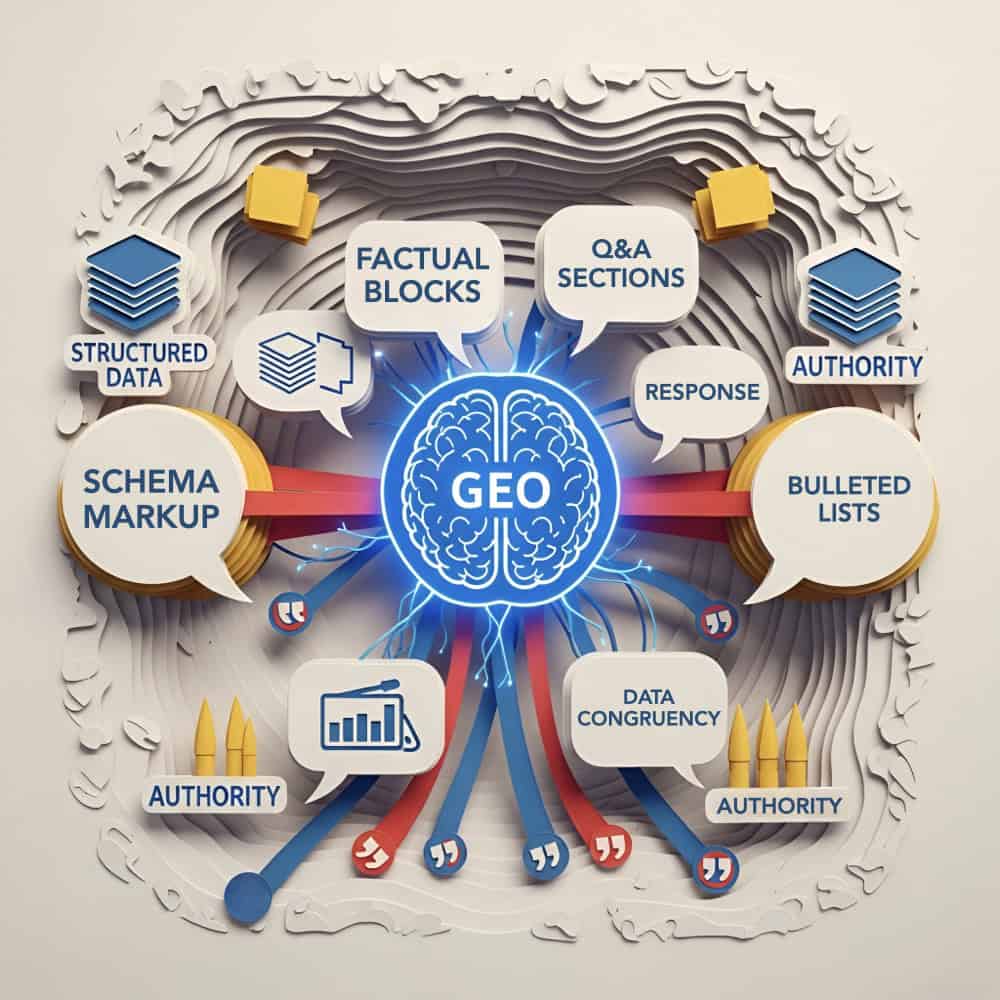
To win in this landscape, your content must be “Modular.” AI engines prefer structured, factual blocks—like tables, Q&A sections, and bulleted lists—over dense walls of marketing copy.
3. Architecting for SEO in the Age of AI Visibility
To stay visible, B2B firms must move toward an Authority Architecture. This involves three critical layers of optimization:
E-E-A-T Verification: “Author Provenance” is now a top-tier signal. Your content must be backed by a verified human expert with a congruent digital footprint.
Semantic Breadcrumbs: Using breadcrumbs in 2026 is no longer just a visual aid; they are a structural blueprint that explains your site’s hierarchy to AI Overviews and crawlers. They turn a simple navigation path into a machine-readable map of your expertise.
Information Gain: AI models are now trained to ignore “me-too” content. To be cited, you must provide unique insights, original research, or proprietary case studies that cannot be found elsewhere.
4. The Congruency Rule for B2B Professionals
For a professional service provider, your digital presence must be a mirror of your real-world reputation. As we explored in our guide on On-Page SEO Factors, trust is killed instantly if your technical data doesn’t match your brand’s claims. When practicing SEO in the age of AI, this “Congruency” is what allows an algorithm to recommend your firm with confidence. If you claim to be an industry leader but lack external citations or social proof, the AI will bypass you for a more “verified” competitor.
If this sounds like technical noise, don’t worry—you aren’t alone. Your job is to lead your industry; our job is to ensure the digital world recognizes that leadership. By leaning on our expertise, you can stop chasing algorithms and get back to serving your clients. Leave the heavy digital lifting to us. Contact us to start a conversation.
Frequently Asked Questions
1. What is the difference between SEO and GEO?
Think of traditional SEO (Search Engine Optimization) like a library catalog. It helps the librarian (Google) find your book and put it on the right shelf so a reader might pick it up.
GEO (Generative Engine Optimization) is more like being the expert the librarian actually quotes. Instead of just showing a link to your website, an AI (like ChatGPT or Google’s AI Overview) reads your content and says, “According to [Your Company Name], the best way to solve this is…” GEO ensures you are the one being cited, not just listed.
2. Will I lose customers if people don’t click on my website anymore?
It’s a valid concern! This is called “Zero-Click Search.” While you might see fewer people clicking onto your homepage for basic info, the ones who do click are usually much higher-quality leads.
If an AI recommends your business as the solution to a complex problem, that customer already trusts you before they even arrive. You aren’t just getting “visitors”; you’re getting “vetted prospects” who are ready to talk business.
3. How does an AI “know” I’m an expert?
AI doesn’t just look for keywords anymore; it looks for proof. It scans for what we call “Experience and Expertise.”
- Do you have real-world case studies?
- Is your name mentioned on other reputable Malaysian business sites?
- Do you provide unique data or insights that others are just copying? By providing original, helpful content rather than generic “fluff,” you give the AI the evidence it needs to recommend you.
4. Do I need to rebuild my entire website for this?
Not necessarily. Most of the time, it’s about “re-architecting” what you already have. We add a layer of “digital labels” (called Schema Markup) that helps the AI understand your services instantly. We also restructure your content into “direct answers”—like a clear FAQ section or bulleted summaries—that are easy for an AI to “lift” and use in a conversation.
5. Can I just use AI to write all my content now?
You can, but it’s a trap. If you use AI to write generic articles, you’re just adding more noise to the internet. AI engines are actually trained to look for “Information Gain”—meaning they prefer content that adds something new. If your website sounds exactly like every other competitor, the AI has no reason to cite you. Your unique human experience is actually your biggest competitive advantage in the AI era.