
Imagine you’re trying to describe a legendary chef. You wouldn’t just repeat the word “cook” five hundred times. You’d talk about their Michelin stars, their signature truffle risotto, the famous kitchen in Paris where they trained, and the critics who adore them. Google and AI engines like Gemini don’t just see “words” anymore; they see Entities. This shift toward Entity-Based Discovery means search engines now connect the dots between people, places, and concepts to understand the true authority and context of your content.
- Shift from Keywords to Identities: Defines the transition from traditional SEO (matching words) to GEO (validating entities). It emphasizes that AI now treats businesses as “objects” with specific attributes rather than just “strings” of text.
- The “Web of Proof” Concept: Explains how AI models synthesize data from fragmented sources—social media, local listings, and third-party citations—to build a 3D profile of a brand.
- Entity Confidence & Trust: Aligns with Google’s Patent on Entity-Based Search, suggesting that the higher the “confidence score” of an entity, the more likely it is to be featured in AI-generated answers.
- Contextual Understanding: Highlights the AI’s ability to understand the intent behind a search. For example, knowing the difference between “Apple” the fruit and “Apple” the tech giant based on the surrounding digital ecosystem.
- Combatting Invisibility: Argues that without a clear entity definition, a brand remains “invisible” to conversational AI agents, even if they rank well in traditional blue-link search results.
- Reputation Congruency: Stresses that a “High-Authority Entity” requires a perfect match between its website data and its external mentions to prevent the AI from flagging the brand as a “Low-Confidence” source.
Think of the old way of searching as a simple word-match. In that era, if you wanted to be found for “Architect,” you just repeated the word until a robot noticed. Today, search engines have evolved into sophisticated concierges. They no longer look for the word you use; they look for the “thing” you are. This means the AI connects your website, your LinkedIn, your physical location, and your media mentions to build a verified 3D profile of your business. To the AI, you aren’t just a collection of text; you are a recognised Entity with a specific reputation.
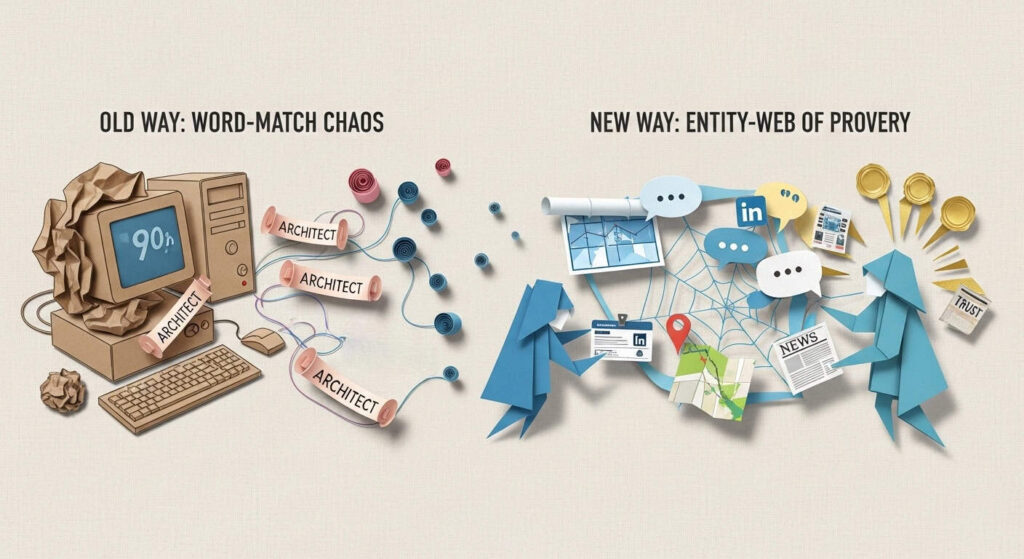
The power of this shift is that the AI begins to understand context rather than just characters. It looks for a “web of proof” to verify your authority. If your website says you’re an expert, but your social media is silent and your local listings are outdated, the “Entity” is weak and the AI won’t trust you. When you master Entity-Based Discovery, you stop begging for clicks by using the right keywords and start being cited as the definitive answer because the AI has connected the dots of your entire digital footprint and verified your existence as a market leader.
The End of the “Word-Stuffing” Era
For years, the internet was a game of repetition. If you wanted to be found for “Digital Consultant,” you made sure that phrase appeared in every third sentence. It was clunky, robotic, and frankly, a bit desperate.
Today, we’ve moved into the realm of Entity-Based Discovery.
AI engines no longer look for the word you used; they look for the context surrounding you.
An “Entity” is a unique, well-defined thing—a person, a brand, a specific concept. AI engines no longer look for the word you used; they look for the context surrounding you. They are looking for the “Who, What, and Where” that proves you aren’t just a website, but a verified authority in the real world.
Why Your Digital Footprint is Fragmented
The biggest mistake SMEs make is thinking their website exists in a vacuum. If your website says you’re an expert in corporate training, but your social media talks only about your weekend golf trips, the AI gets confused.
To the machine, you are a “weak entity.”
Entity-Based Discovery works by connecting the dots. It looks at your LinkedIn, your press releases, your guest articles, and your website. If they all point to the same specialized “Entity,” you become a “Primary Source.” When a user asks an AI for a recommendation, the engine feels confident citing you because your digital footprint is congruent.
From Keywords to Entity-Based Discovery Ecosystems
At DigitalVillage, we don’t just hunt for high-volume keywords. We architect the nodes of your business. We define:
- The Relationship: How your services connect to the problems your clients face.
- The Provenance: Where your expertise comes from (awards, citations, history).
- The Reputation: What other authoritative entities (like news sites or industry bodies) say about you.
When you shift your focus to Entity-Based Discovery, you stop begging for traffic and start commanding attention. You aren’t just another link in a search result; you are a verified destination in the AI’s knowledge graph.
Frequently Asked Questions
If keywords are “dying,” should I stop doing keyword research entirely?
Not at all. Think of keyword research as the “vocabulary” of your audience, while entity-based discovery is the “identity” of your brand. You still need to know the words your customers use to describe their pain points. However, instead of obsessing over the exact phrasing, use those keywords as a compass to guide you toward the broader concepts (entities) you need to master. Keywords tell you what people are asking; entities ensure you are the authority they find.
How do I practically “define” my entity to Google?
The most effective “birth certificate” for an entity is Schema Markup. This is a piece of code (structured data) that acts as a translator for AI. While the article discusses the concept of being a “3D object,” Schema is the technical tool that tells the AI: “This business is an ‘organisation’, this person is the ‘Founder,’ and this case study is ‘Evidence’ of our expertise.” Without Schema, you’re asking the AI to guess who you are; with it, you’re handing it a verified ID.
Can a small SME really compete with a giant brand in an “Entity-Based” world?
Surprisingly, yes. In the old keyword-stuffing era, big budgets often won by sheer volume. In the entity era, niche authority wins. AI engines value “Reputation Congruency.” If a giant brand is a “jack-of-all-trades” but your digital footprint—from your guest posts to your local citations—unanimously points to you being the definitive expert in “Boutique Architecture in Kuala Lumpur,” the AI will often cite you over a global firm for that specific context.
What is the fastest way to fix a “Weak Entity” profile?
Start with Digital Congruency. Most SMEs have a “fragmented” identity: a website that says one thing, a LinkedIn that says another, and a Google Business Profile that hasn’t been updated in two years. To the AI, these are conflicting signals. Your first step should be an “Entity Audit”—ensuring your name, address, core services, and expertise are identical across every digital node you touch. Consistency is the primary signal of trust for a machine.
Does my personal brand as a founder affect my company’s “Entity Score”?
More than ever. Search engines use a concept called E-E-A-T (Experience, Expertise, Authoritativeness, and Trustworthiness). The AI connects the “Founder Entity” to the “Business Entity.” If you are cited as an expert on external platforms, the AI passes that authority through to your company. At DigitalVillage, we call this the “Authority Loop“—your personal reputation and your business presence should feed into each other to create a single, unshakeable node of proof.
If keywords are being replaced by entities, how do I ensure my content is still discoverable?
While search engines now focus on “entities” (concepts, people, and things) and their relationships, they still use the context of a query to determine relevance. The most effective way to bridge this gap is by mastering Search Intent SEO. By aligning your entity-rich content with the specific intent—whether a user is looking for information, a specific brand, or a product—you provide the necessary “connective tissue” that helps AI-driven engines recognise your site as the most authoritative answer.